

There was a time, not long ago, when “receipts” meant an actual receipt. Crumpled paper. Coffee stains. A date and time you could squint at like it was sacred text. Now it means a screenshot of a chat, often cropped with the care of a true artist, floated into a group chat like a grenade. Everyone leans in. Everyone suddenly turns into a handwriting analyst, except the handwriting is Helvetica and the ink is vibes.
Discord, in particular, has become a kind of community living room where people argue about everything from game balance to politics to who “stole” whose joke. It’s also where accusations spread at the speed of a ping. And because so much of Discord culture lives in logs, DMs, and “what you said at 2:14 a.m.,” the screenshot has become the internet’s favorite courtroom exhibit, even when there is no court and the jury is mostly sleep-deprived strangers.
The screenshot as a social weapon
The modern screenshot does two things at once. It freezes a moment, and it flattens it. Tone is gone. Context is gone. The ten messages above it that explain the entire exchange are, mysteriously, gone. What remains is a clean rectangle that says, “Look. This happened.” The internet loves a rectangle. It fits neatly into the part of our brains that craves certainty.
In Discord drama, “logs” carry a special authority. They sound official, like something produced by a neutral machine. A log feels less like gossip and more like evidence. Which is why it’s such a delightfully dangerous format to fake. Once you can fabricate logs, you can manufacture reality, or at least manufacture enough of it to get someone kicked from a server, doxxed, or turned into the day’s villain.
The problem is not that people lie online. People have always lied online. The problem is that lying has become frictionless, and the output looks exactly like what truth looks like on a phone screen.
A thriving market for believable nonsense
If you want to make a fake chat screenshot today, you do not need Photoshop skills or a friend who “knows design.” You need five minutes, a mildly evil impulse, and a browser. Tools like fake discord chat make it trivial to mock up conversations across an absurdly wide menu of platforms, not just Discord but WhatsApp, Instagram, iMessage, Telegram, Slack, Signal, X, TikTok, Snapchat, Teams, even Tinder and OnlyFans. Some of that is harmless. People use these generators for memes, skits, classroom examples, UX wireframes, storyboards, film and TV mockups, and other creative work where you want the look of a chat without the hassle of staging one.
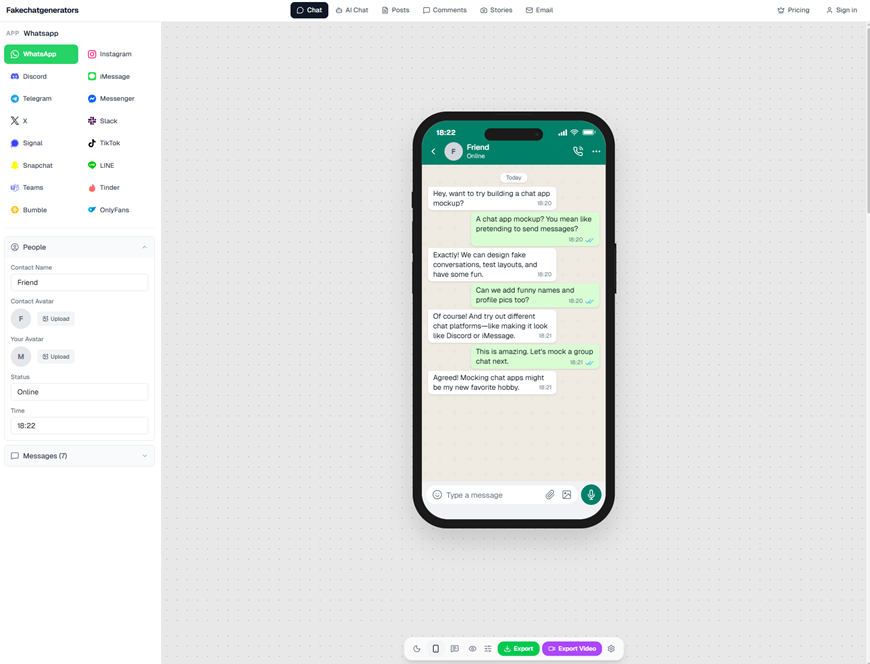
fakechatgenerators.com lets you mock up chat screenshots across 16 platforms
But the same convenience that helps a student illustrate a scenario for a presentation also helps a grudge turn into “proof.” The interface does not ask why you’re doing it. It just hands you the finished product, neat and shareable. And once it’s in the wild, the burden shifts. The accused has to explain. The audience gets to enjoy the spectacle.
This is one of the internet’s older tricks: the person making the claim does the easy part, and the person defending themselves inherits the hard part. “Prove you didn’t say this” is a maddening request in a medium where nothing is stable and everything can be edited, deleted, or screenshotted at the worst possible moment.
Why we keep falling for it (even when we know better)
You might think people would be more skeptical by now. After all, we’ve been warned for years that images can be manipulated, headlines can be misleading, clips can be taken out of context. Yet the screenshot keeps winning.
Part of it is emotional efficiency. A screenshot is fast. It offers a tidy narrative with a villain and a payoff. It also provides the thrill of insider knowledge, the sense that you’re seeing what you were never meant to see. That feeling is catnip, and it lowers standards instantly. Nobody wants to be the person in the room saying, “Wait, do we know this is real?” because that person is often treated like a buzzkill or, worse, an accomplice.
The other factor is that screenshots match the way we already experience online life, chopped into fragments. We are used to consuming conversations as highlights. We accept that a single message can define a person. We accept that one bad moment can override five years of normal behavior. The format trains us to overvalue the fragment, then punishes us for not questioning it.
The arms race: generating fakes vs. proving authenticity
As fabrication tools get smoother, verification tools have to get sharper. That’s the part people tend to skip, because verification is boring and drama is fun. Still, there’s a growing class of services built for the opposite task: flagging AI-generated or altered media and spotting tampered documents before they become tomorrow’s “everyone is talking about this” post.
One example is an ai image detector positioned for journalists, trust and safety teams, banks, marketplaces, and legal groups, the kind of people who can’t afford to shrug and say “looks real to me.” It claims 98.7 percent detection accuracy across more than 50 generative models (Midjourney, DALL-E, Stable Diffusion, Flux, Ideogram, Google Gemini, GANs) and sub-150ms latency. Those numbers are impressive, and they also underline something slightly grim: we are building a technical infrastructure for skepticism because casual human judgment has become unreliable.
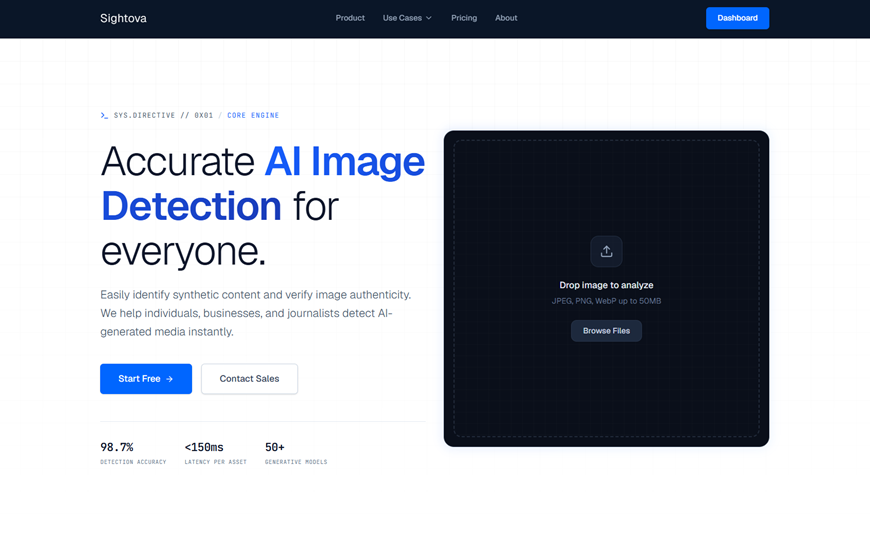
sightova.com flags AI-generated, tampered, NSFW, and violent imagery in milliseconds
Even then, detection is only part of the story. A detector can tell you something looks suspicious, but it can’t necessarily restore trust in a community that already picked its side. It can’t undo the quote tweets. It can’t rewind the server blow-up where fifteen people left and three friendships died.
Discord’s particular vulnerability: intimacy plus scale
Discord feels private even when it isn’t. Servers have channels, roles, in-jokes, long-running feuds. You’re not posting into the open void, you’re talking “with your people.” That creates intimacy. It also creates a false sense of safety.
Then something leaks. Or someone shares a screenshot “just to a few friends.” And suddenly the server is dealing with a public scandal that started in what felt like a semi-private room. The result is a constant tension: communities that behave like small towns but can explode like major cities.
Fabricated logs thrive in that tension. They can be customized to the exact social topology of a server. The right usernames, the right nicknames, the right timestamps. A fake doesn’t have to be perfect, it just has to be plausible enough to give everyone permission to believe what they already suspected.
What the new “truth” looks like
The old internet truth problem was misinformation, the public kind. Fake news sites. Viral hoaxes. Obvious scams. The new truth problem is interpersonal. It’s micro-targeted. It’s the weaponization of credibility inside communities where people already have history. It’s not “breaking news,” it’s “look what he said to me.”
And the damage isn’t just reputational. It’s administrative. Moderators become investigators. Friends become attorneys. People start archiving everything, not because they’re paranoid but because they’ve learned the cost of being unable to prove what happened. Conversation turns stiff. Humor becomes risky. Everyone starts talking like they’re being cross-examined, because they might be.
The irony is that the more we demand receipts, the more incentive there is to manufacture them.
A few habits that help (without turning you into a detective)
You don’t need to become a forensic analyst to survive this era, but you do need a few new reflexes.
First, distrust the perfectly cropped screenshot. Real conversations are messy. They include awkward transitions, typos, and boring filler. A clean, cinematic exchange should trigger at least a little suspicion.
Second, ask for context in a specific way. Not “show more” but “what was said right before this” and “where is this posted” and “is there a message link.” On Discord, a message link, when available, is harder to fake than an image.
Third, slow down. Drama relies on urgency. The screenshot wants you to react before you think. Waiting ten minutes is not cowardice, it’s sanity.
Finally, treat verification as a community norm, not an individual quirk. The healthiest servers are the ones where “let’s confirm this” is seen as responsible, not disloyal.
Truth online is not disappearing, but it is getting more expensive. It costs more time, more doubt, more patience. The cheap stuff, the instantly shareable rectangle with a damning line in the middle, will keep circulating because it’s convenient and because it flatters our instincts.
The trick is remembering that convenience is not the same thing as reality. And that a screenshot, no matter how crisp, is still just a story someone wants you to believe.